WOW!!! Preliminary election results named Michel Martelly as the new President of Haiti and the streets immediately erupted in joy - screaming, chanting, singing, horns, gunfire, for two hours and it doesn't seem to be letting up. We were all sent home early today in anticipation of the announcement and have a delayed start tomorrow, depending on the level of activity in the streets in the morning.
Tet Kale (bald head as he is nicknamed) has an enormous job in front of him and I just read a Tweet that said it all, "I wonder if Tet has had the "oh, shit" moment yet". He is one of Haiti's best known Kompa singers who is infamous for taking his clothes off while performing and has no prior government experience but definitely has the hearts of many Haitians and maybe that is what it will take. Having lived in a state with a professional wrestler as governor I have kept my mouth shut on the issue. He isn't a fan of NGO's being here, so it will be interesting to see how that plays out when he officially takes office on May 7th.
If you'd like to read more about him, here is a quick article with some info:
http://www.msnbc.msn.com/id/42421207/ns/world_news-americas/
Monday, April 4, 2011


Sunday, March 13, 2011
Jerry
Throughout Port au Prince amazing street art is found in random places, the best includes the same trademark signature "Jerry". He's incredibly talented and has gained quite a following. We've learned about him through various people who know people who know Jerry. We were lucky enough to run into Jerry leaving an art gallery where he was dropping off invitations for a "Friends of Jerry" event a few people helped him put together.

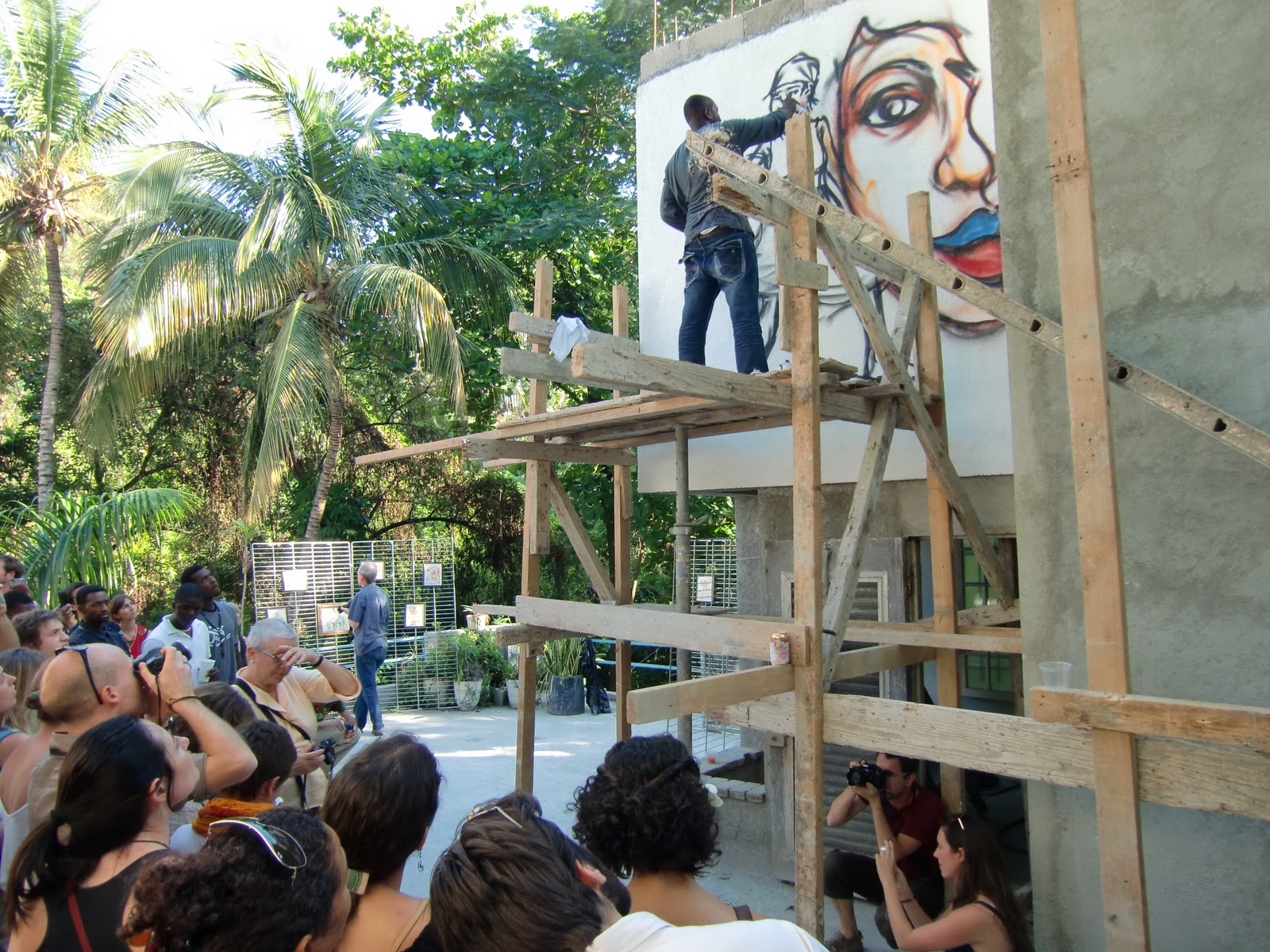
The event was today and it was amazing! His friends prepared a wall and he did a live demo. He's incredibly shy so there was no speech or information shared, but after a quick introduction he turned to face the wall, spent a few minutes thinking, and then just 11 minutes later he put the finishing touches on the painting.
He also had approximately 15 small watercolors for sale. Based on the orders placed today he will now do up to 50 of each, numbered, to be picked up within two weeks. I'm very excited to see our new art! He charged $50 each... there is a gallery in town that has bigger canvases of his work for $2,000.
I've included some of Jerry's street art that I've captured over the last year as well as photos from today.


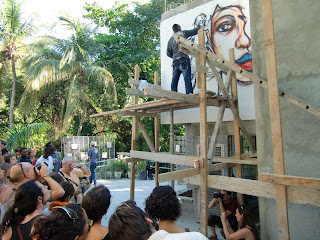


The event was today and it was amazing! His friends prepared a wall and he did a live demo. He's incredibly shy so there was no speech or information shared, but after a quick introduction he turned to face the wall, spent a few minutes thinking, and then just 11 minutes later he put the finishing touches on the painting.
He also had approximately 15 small watercolors for sale. Based on the orders placed today he will now do up to 50 of each, numbered, to be picked up within two weeks. I'm very excited to see our new art! He charged $50 each... there is a gallery in town that has bigger canvases of his work for $2,000.
I've included some of Jerry's street art that I've captured over the last year as well as photos from today.


 |
| His use of other elements like the two real trees holding up this hammock are so creative. |


 |
| Jerry's Introduction |
 |
| Contemplation |
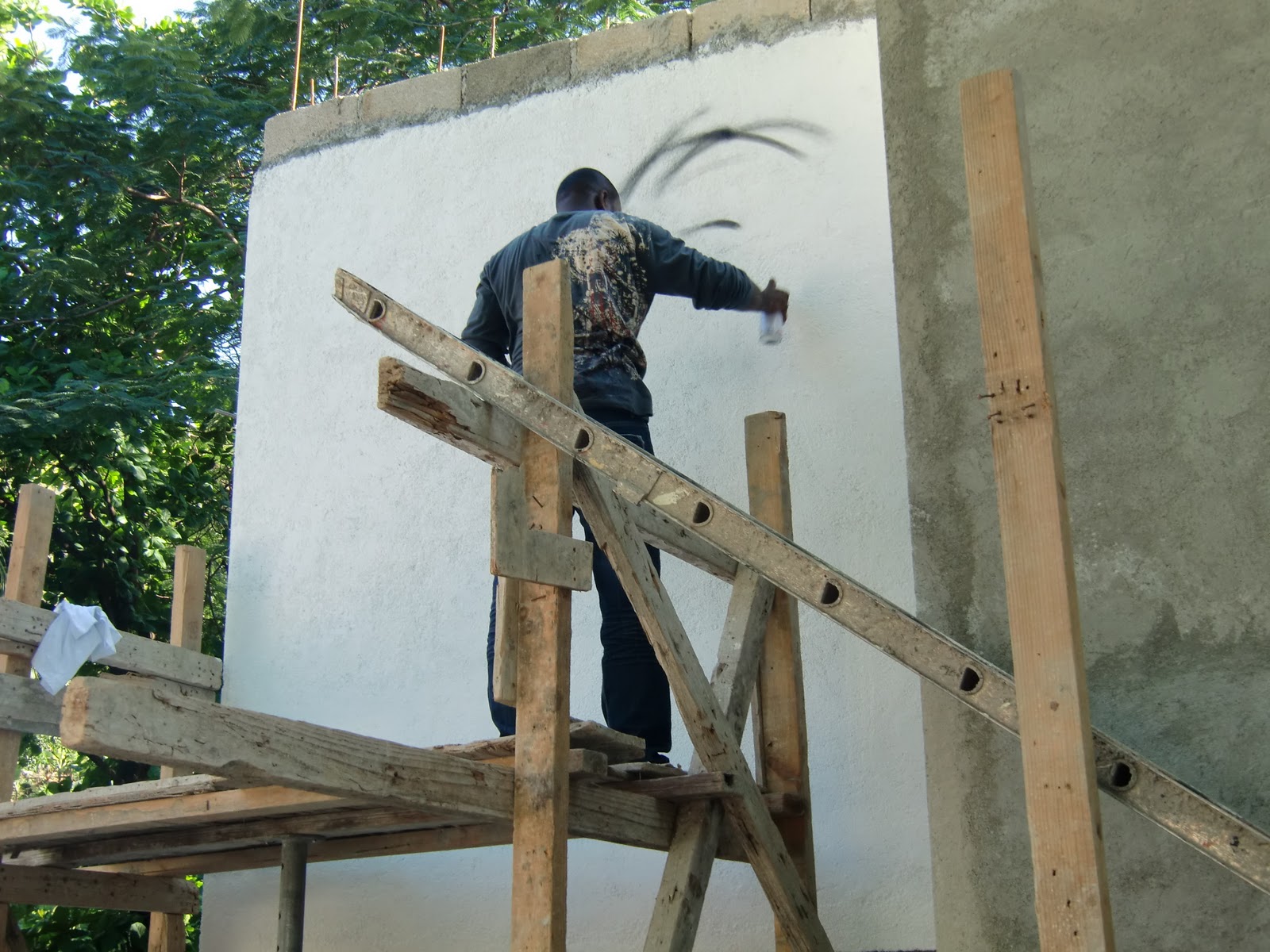 |
| First sprays. |



 |

 |
| The finished work - just 11 minutes. |
 |
| Entertainment |
 |
| Jerry with the watercolors he painted. |
 |
| One of the watercolors. |
Saturday, March 12, 2011
A More Informed Life
The longer I live here the more I find that the things I thought to be true from our occasional visits over the last nine years are in fact far different from reality. I'm not sure if it's that the people we know are trusting us and starting to reveal more or if it's simply that after stringing so many days together we've just observed more.
For instance, I was told many years ago that one of the reasons traffic is so crazy here is that anyone can simply start to drive when they decide they'd like to. I'm sure there are people that do, in fact, do that. I observed the reality this week while waiting for someone in one of the busy blocks in Petion-ville. I saw three of the most decrepit, crashed up cars with students in the drivers seat and instructors in the passenger seat. I'm not sure how long they'd been at it, but after I'd noticed them they spent another 20 minutes driving maybe 5 mph in a somewhat straight line on one of the slower sides of the street. When they reached the end of the block they put the car in reverse and the instructor took the wheel to back them up to the starting point. Over and over again. Occasionally they would add a crazy dynamic, like passing one of the other student drivers. It was like watching in slow motion. After the aforementioned 20 minute period they all three lined up and went all the way around the block. Two attempts at that and they parked the cars, the students said goodbye and went their own way.
Another example has to do with Haitian dogs. They are strays and there are literally thousands of them. For the most part they are fairly healthy looking dogs and depending on which part of the city look somewhat well fed. Over the last year I've observed how that happens, and it doesn't involve garbage piles (those are left to the goats and pigs). When I'm working in neighborhoods we will occasionally break for lunch. Lunch with my Haitian staff is either A) Brought from home, B) Purchased from a street vendor (picture a tarp strapped to four poles under which is the two foot charcoal stove with giant cauldrons of rice, beans, meat, etc. or C) Eaten at a neighborhood "restaurant". This is where to dogs come in...The restaurants in neighborhoods are typically created by adding a tarp (again with the poles, but generally a much larger space is covered) and moving the entire kitchen stove under the tarp. Plastic tables and a variety of chairs are added for diners. It's somewhat like a greasy spoon in the U.S. with the women that are cooking and serving yelling orders back and forth. There is no menu - you eat what they are serving, and the concept of vegetarian is NOT understood. For anyone that knows me well, I am not a fan of meat unless it's a nicely grilled chicken breast or delicious cut of steak. I've had to let go of the surprise (shock) at finding random pieces and parts in things - like the crab claw and chicken knuckle I found in what they called their vegetable dish for the day. I was in a new neighborhood place last week and decided to try to place a vegetarian order again. Their interpretation to this is that I didn't want the chicken so they went into a cooler and created something that looked like a meatball. I, of course, was grateful to them for going over and above. I was then even more grateful to my co-worker that explained that this was the perfect reward for the dog that had been patiently sitting at my feet. I had always noticed all of the street dogs that make their way into these restaurants and had seen them begging but I now noticed the order of things. Each of the six dogs in the restaurant had staked out 2 of their own people. An extra dog wandered by, looked in from the street, noticed that everyone was spoken for and kept on walking. The thing that amazed me most was that while I was a little nervous that this dog might not understand what was meatball and what was fingers, he very gently took the food from my fingers. After a few minutes he put his little paw on my foot, probably just a reminder that he'd like more.
A non-dog random note, as I mentioned to Al last night. My entire ability to move beyond the fact that the woman that takes the dirtiest money you've ever seen (I'd eat off of American dollars at this point) then waves a few flies away and grabs my fried plantains out of the pan with the same hand no longer fazes me. Of course, we try to use just a few vendors that we "know" because of the whole Cholera thing, but overall it's tough to get by without indulging occasionally. A big benefit of this type of experience is that you can get an enormous plate of rice and beans, meat (generally a chicken leg, pork or goat), banan frit (fried plantains), piklez (very spice cabbage) and for extra carbs a scoop of cold pasta salad for just under $2.
On the other end of the spectrum, we've experienced some really good fine dining. Last night we went to a restaurant called Chicken Fiesta with some friends. The fact that it was Chinese American was a small surprise based on the name, but it was really good! It's run by a Haitian woman that lived in the Bronx until the recession hit and then couldn't make her restaurant go anymore. She moved here and opened near our apartment. We each had dinner and two beers and it was $50 for both of us. It's generally U.S. standards for cleanliness, but it's not affordable for the average person here. Expat / NGO workers and the Haitian upper class are the typical customers.
For instance, I was told many years ago that one of the reasons traffic is so crazy here is that anyone can simply start to drive when they decide they'd like to. I'm sure there are people that do, in fact, do that. I observed the reality this week while waiting for someone in one of the busy blocks in Petion-ville. I saw three of the most decrepit, crashed up cars with students in the drivers seat and instructors in the passenger seat. I'm not sure how long they'd been at it, but after I'd noticed them they spent another 20 minutes driving maybe 5 mph in a somewhat straight line on one of the slower sides of the street. When they reached the end of the block they put the car in reverse and the instructor took the wheel to back them up to the starting point. Over and over again. Occasionally they would add a crazy dynamic, like passing one of the other student drivers. It was like watching in slow motion. After the aforementioned 20 minute period they all three lined up and went all the way around the block. Two attempts at that and they parked the cars, the students said goodbye and went their own way.
Another example has to do with Haitian dogs. They are strays and there are literally thousands of them. For the most part they are fairly healthy looking dogs and depending on which part of the city look somewhat well fed. Over the last year I've observed how that happens, and it doesn't involve garbage piles (those are left to the goats and pigs). When I'm working in neighborhoods we will occasionally break for lunch. Lunch with my Haitian staff is either A) Brought from home, B) Purchased from a street vendor (picture a tarp strapped to four poles under which is the two foot charcoal stove with giant cauldrons of rice, beans, meat, etc. or C) Eaten at a neighborhood "restaurant". This is where to dogs come in...The restaurants in neighborhoods are typically created by adding a tarp (again with the poles, but generally a much larger space is covered) and moving the entire kitchen stove under the tarp. Plastic tables and a variety of chairs are added for diners. It's somewhat like a greasy spoon in the U.S. with the women that are cooking and serving yelling orders back and forth. There is no menu - you eat what they are serving, and the concept of vegetarian is NOT understood. For anyone that knows me well, I am not a fan of meat unless it's a nicely grilled chicken breast or delicious cut of steak. I've had to let go of the surprise (shock) at finding random pieces and parts in things - like the crab claw and chicken knuckle I found in what they called their vegetable dish for the day. I was in a new neighborhood place last week and decided to try to place a vegetarian order again. Their interpretation to this is that I didn't want the chicken so they went into a cooler and created something that looked like a meatball. I, of course, was grateful to them for going over and above. I was then even more grateful to my co-worker that explained that this was the perfect reward for the dog that had been patiently sitting at my feet. I had always noticed all of the street dogs that make their way into these restaurants and had seen them begging but I now noticed the order of things. Each of the six dogs in the restaurant had staked out 2 of their own people. An extra dog wandered by, looked in from the street, noticed that everyone was spoken for and kept on walking. The thing that amazed me most was that while I was a little nervous that this dog might not understand what was meatball and what was fingers, he very gently took the food from my fingers. After a few minutes he put his little paw on my foot, probably just a reminder that he'd like more.
A non-dog random note, as I mentioned to Al last night. My entire ability to move beyond the fact that the woman that takes the dirtiest money you've ever seen (I'd eat off of American dollars at this point) then waves a few flies away and grabs my fried plantains out of the pan with the same hand no longer fazes me. Of course, we try to use just a few vendors that we "know" because of the whole Cholera thing, but overall it's tough to get by without indulging occasionally. A big benefit of this type of experience is that you can get an enormous plate of rice and beans, meat (generally a chicken leg, pork or goat), banan frit (fried plantains), piklez (very spice cabbage) and for extra carbs a scoop of cold pasta salad for just under $2.
On the other end of the spectrum, we've experienced some really good fine dining. Last night we went to a restaurant called Chicken Fiesta with some friends. The fact that it was Chinese American was a small surprise based on the name, but it was really good! It's run by a Haitian woman that lived in the Bronx until the recession hit and then couldn't make her restaurant go anymore. She moved here and opened near our apartment. We each had dinner and two beers and it was $50 for both of us. It's generally U.S. standards for cleanliness, but it's not affordable for the average person here. Expat / NGO workers and the Haitian upper class are the typical customers.
Monday, March 7, 2011
Abilities
There are some nice soccer fields near the airport that have been the site of some of the amputee soccer league practices and games. The Challenged Athletes Foundation held a running clinic there on Saturday for people with amputations.
One of the people leading the clinic was an American who was born without legs. He lives in California and can run 100 meters in 11 seconds (pictured below). A big group of able bodied kids had just finished playing soccer and gathered around him when he arrived. He asked if they thought he could run. When they said "no way" he challenged them to a race - he won, which will hopefully go a long way in helping them understand the abilities of people with disabilities.
 He was very inspirational for those participating and almost as important were the people that became observers, including the group of kids he raced.


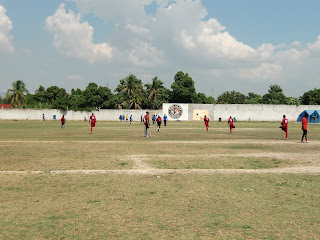
One of the people leading the clinic was an American who was born without legs. He lives in California and can run 100 meters in 11 seconds (pictured below). A big group of able bodied kids had just finished playing soccer and gathered around him when he arrived. He asked if they thought he could run. When they said "no way" he challenged them to a race - he won, which will hopefully go a long way in helping them understand the abilities of people with disabilities.


Saturday, February 26, 2011
Gardening in February

To provide hope of Spring for all of you in Northern climates, here are a few photos from our garden, taken just a few minutes ago. It's been fun to watch how fast our garden grows!
 |
| We planted these tomato seeds on February 1st. |
 |
| Our basil isn't looking as good, but still exciting progress. |
 |
| This pot was my first successful purchase done on the street, negotiating with the guy that made it. We found these plants in an abandoned house near our apartment. They've really taken off! |
 |
| We found some of these little plants in a rocky area near our apartment and transplanted a few. They just started blooming. |
Sunday, January 30, 2011
Progress
T-shelters are transitional shelters. They are meant to get people out of camps and back into their original neighborhood. For people that remained on their land but are living in tents, it provides more stability and security. They are designed and built to last from 2-5 years, hopefully holding up until a permanent option is found. With land ownership rights still a work in progress at higher levels, t-shelters are considered "furniture", meaning if we build for someone that ultimately isn't the legal property owner they can take the materials and leave. Because documentation of land ownership is not available in most cases, we work with neighbors to get verification.
I have been leading an amazing team of 49 employees that are finding the land where we can build,locating the families that own or can rent the property, and then writing applications and contracts. It has been very rewarding to watch them gain confidence, find their voices and work together as a well run machine. The neighborhoods are so tightly packed it becomes a puzzle with houses that need to be torn down, piles of rubble from people that have demolished their houses and in between it all are tiny parcels of land that they find.
The construction team started building almost two weeks ago and they are steadily making progress. Over 60 families are now moved into their new homes.
Coordination between organizations providing the same services is almost a full time job. With 100,000 families in need of t-shelters we are working hard to create a better map and stop working in the same neighborhoods. Right now we seem to be writing contracts with the same families.
I have been leading an amazing team of 49 employees that are finding the land where we can build,locating the families that own or can rent the property, and then writing applications and contracts. It has been very rewarding to watch them gain confidence, find their voices and work together as a well run machine. The neighborhoods are so tightly packed it becomes a puzzle with houses that need to be torn down, piles of rubble from people that have demolished their houses and in between it all are tiny parcels of land that they find.
The construction team started building almost two weeks ago and they are steadily making progress. Over 60 families are now moved into their new homes.
Coordination between organizations providing the same services is almost a full time job. With 100,000 families in need of t-shelters we are working hard to create a better map and stop working in the same neighborhoods. Right now we seem to be writing contracts with the same families.
 |
| Training my new team on site |
 |
| Classroom Training |
 |
| More on site training. |
 |
| Our first T-shelter family - mom declined the photo opportunity. |
 |
| As neighbors see the opportunity for a new home they begin clearing their rubble. |
 |
| The rubble is taken to the street where a partner organization of ours takes it away. |
 |
| Some of my team leaders - Marco, Magloire and Jeanel. |
 |
| A team gets paperwork together for another family. |
 |
| Immacula interviews a family. |
 |
| When we have houses that need to be torn down, like the one shown here, we partner with another organization to bring in heavy equipment. It helps to make the neighborhood safer and provides space for more T-shelters and hopefully soon, permanent housing. |
Monday, January 17, 2011
More from the land of contrasts
The Healing Hands for Haiti board met at one of our favorite beach resorts over the weekend. All reports were positive that real progress was made and I was happy to be a part of it all, with a little extra time with friends and a good book on the beach.
We arrived back in Port au Prince last night at almost the same moment the news hit the street that Baby Doc Duvalier had returned to Haiti after 25 years in exile. In yet another moment that reminds us to never be surprised at what can happen in Haiti, I'm still truly astounding that a) he is really here; b) he wasn't arrested on humanitarian rights violations the moment he landed; and c) there are people that remember the "order" he created and are happy to see him, somehow leaving out the actual facts of his "reign". Of course we'll be watching developments closely but for now everything is quiet and he seems to be staying close to his hotel.
On a brighter note - Al, Healing Hands and the Haitian amputee soccer team received some nice coverage on the CBS Sunday Morning Show. It's the stories like this that keep our hopes for a better Haiti alive! Watch it here:
http://www.cbsnews.com/video/watch/?id=7252391n&tag=cbsnewsVideoArea.0
 |
| View from my chair at the beach |
On a brighter note - Al, Healing Hands and the Haitian amputee soccer team received some nice coverage on the CBS Sunday Morning Show. It's the stories like this that keep our hopes for a better Haiti alive! Watch it here:
http://www.cbsnews.com/video/watch/?id=7252391n&tag=cbsnewsVideoArea.0
Subscribe to:
Posts (Atom)